
Read Bourbon County Property Tax Records by Source
The Bourbon County PVA identifies, lists, classifies, and assesses property as of January 1. The Sheriff collects the bill. The Treasurer handles county financial administration but does not replace the Sheriff as tax collector.
| Field | What It Shows | Where |
|---|---|---|
| Fair cash assessment | January 1 taxable-property valuation | Bourbon PVA |
| Classification and exemptions | How the parcel is treated on the roll | Bourbon PVA |
| Current bill and status | Amount, timing stage, and payment | Bourbon County Sheriff |
| Delinquent certificate | Transferred unpaid bill and statutory additions | County Clerk and county attorney |
| Municipal component | City rate where the legal tax district applies | PVA schedule and city collector |
Read the numbers for what they are. The assessment is not a deed's sale price, and the bill is not an appraisal. Bourbon PVA applies market, cost, and income approaches and reviews all property on a four-year cycle, though any area can be reviewed at any time.
Bourbon County's Tax Calendar Changes the Amount
The Sheriff's property-tax guidance lays out a staged calendar. Pay in November and take a 2 percent discount; December is the base amount. January adds a 5 percent penalty. From February 1 through April 15 the penalty is 21 percent. After April 15, unpaid bills move to the County Clerk with added fees.
Postcards and mailed bills go to the homeowner. KRS 134.119 postmarks are accepted, so keep mailing evidence. Confirm the current year's dates instead of trusting a past bill as the live calendar.
Follow a Bourbon County Tax Bill from Roll to Receipt
The Sheriff's page links to an outside View/Search Taxes system. Its live fields and result display may change. Start from the official page and rely only on what the current interface shows. If the search fails, call or visit the Sheriff. The office sits at 301 Main Street, Suite 104, Paris. Bring the parcel number and tax year.
- Find the parcel and assessment year through the PVA.
- Search the Sheriff's current tax route or ask the office by parcel and year.
- Match district, owner label, assessed amount, payment stage, and receipt.
- Check the PVA separately for exemption status.
- After transfer, ask the Clerk for the certificate of delinquency and current balance.
- Assessment date
- The January 1 valuation snapshot.
- Levy or rate
- A tax component applied by the relevant district.
- Homestead exemption
- Qualified relief tied to age or disability and ownership-occupancy rules.
- Certificate of delinquency
- The lien record created after an unpaid bill transfers from the Sheriff.
Contest a Bourbon County Assessment in the Right Order
Appeals run in a fixed order. Bourbon PVA describes an informal conference before the tax-roll inspection period closes. The owner's written conference summary goes to the County Clerk with the appeal form. A three-member Local Board of Assessment Appeals then hears the matter. Useful evidence includes a recent appraisal, an insurance policy, and recent comparable sales.
The local guidance sets a filing deadline. It falls one working day after the inspection period closes. The third Tuesday in May appears only as an example for a third-Monday close. Check the current year's notice before acting.
Appeal window. Complete the PVA conference and verify the current County Clerk filing deadline. A prior year's example is not the live deadline.
January 1 Explains a Bourbon County Owner Mismatch
A January 1 mismatch is normal, not an error. Property sold after that date can keep the prior owner's name on the bill. The name stays that way until the next year. A buyer before August 1 may appear as "c/o" or not at all. Yet a closing adjustment can still push payment onto the buyer. Both the current deed and the older tax label can be accurate. Each one is accurate for its own date.
Changing the name at the PVA takes a recorded deed, will, or death certificate. Compare the recording date, assessment year, and tax year before reporting any mismatch.
Homestead and Disability Relief Has Its Own Record
Relief programs carry their own paperwork. The PVA lists a $49,100 homestead or disability exemption for 2025 and 2026. It applies to county and city taxes. Eligibility requires age 65 or total disability. Applicants must also own and occupy the home as a personal residence on January 1. Disability proof can include a Notice of Award or TPQY. It must show onset, eligibility, and year-round payment verification. This application is separate from an assessment appeal. Verify the current amount and required proof with the PVA before filing.
Payment Channels for Bourbon County Property Tax
The Sheriff takes domestic checks, debit or credit cards, cashier's checks, cash, money orders, and personal or business checks. Cards work in person and carry a listed 3.5 percent fee. A returned check draws a listed $50 fee under KRS 514.040(4)(b).
Make mailed payment payable to the Sheriff at 301 Main Street, Suite 104, Paris, KY. For a record or receipt, call 859-987-2130 and confirm current methods and fees.
After April 15, the Bourbon Tax Record Changes Hands
Kentucky Revenue explains what happens next. The transferred bill becomes a certificate of delinquency and a lien. Interest accrues at 1 percent per month. A 10 percent County Clerk fee and a 20 percent county-attorney fee are added on. Required notices follow, and installment plans may be available.
Clerks begin offering certificates to third-party purchasers in mid-July, with sale activity running into fall. A historical state schedule listed Bourbon's 2025 sale on August 6. That date is not a current notice. Rely on the current Clerk and Revenue delinquent-tax guidance.
A certificate is not immediate ownership. It is a lien subject to statutory notice, collection, redemption, priority, and possible foreclosure rules.
City Rates Require Bourbon Tax-District Proof
The 2025 PVA schedule lists municipal real-property components of 0.1123 per $100 for Paris, 0.336 for Millersburg, and 0.215 for North Middletown. Those are dated city components, not complete rates. A postal city name proves nothing about the legal tax district a parcel sits in.
Paris separately publishes a city tax page and a dynamic bill-search shell. For any city parcel, verify the current year, district, exemptions, and every county, school, and special component before estimating a bill.
Request a Missing Bourbon County Tax Record
When the online lookup comes up empty, request the bill, receipt, assessment year, district, and transfer status by parcel number and tax year. Ask directly whether an unpaid account has become a certificate of delinquency. Also ask where the current public list is kept. Bourbon County publishes no stable delinquent list, so a stale schedule is no substitute. The county Sheriff and the Paris city collector follow different calendars. Pay attention to which office holds the account. A written Kentucky Open Records Act request can seek an existing tax record, subject to eligibility rules, exemptions, copy costs, and redaction. Use public tax data for lawful property diligence only.
See Kentucky's Delinquent-Tax Process
The Kentucky Revenue delinquent-property-tax page covers the statewide handoff.
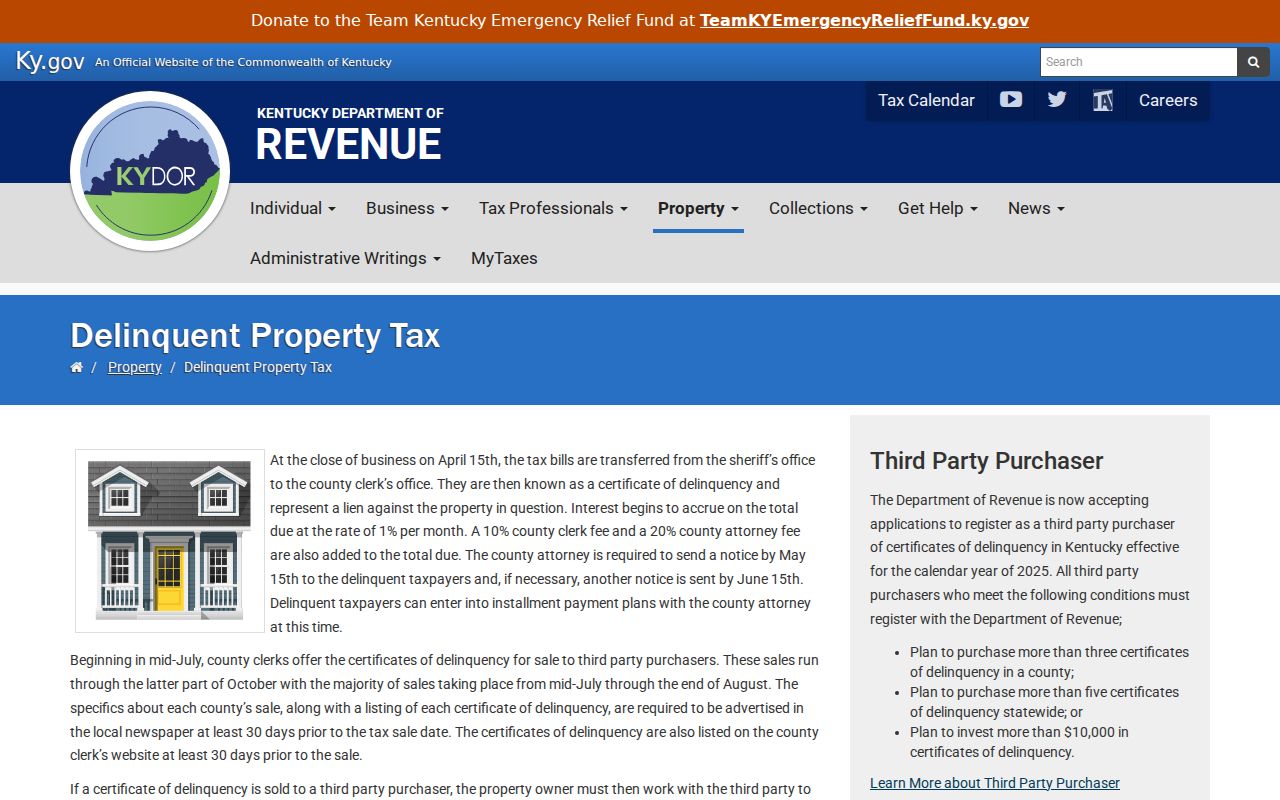
The state page gives process context only. For a current local certificate, balance, or sale notice, the Bourbon County Clerk remains the source.
Separate Bourbon County Assessment and Collection Roles
In Bourbon County, assessment and collection sit with different offices. The PVA values and classifies each parcel. The Sheriff collects the current county tax bill. Once a bill goes delinquent, the County Clerk takes over. The county attorney joins in on the certificate of delinquency. Keeping these roles straight matters. A payment question sent to the valuation office goes nowhere. An assessment dispute is not a collection issue. Record the parcel number and the assessment year. Add the tax year, district, and owner of record. Note the face amount, payment status, and penalty stage. Include any receipt or certificate reference. A city bill, if one applies, is a separate municipal record. Paris publishes its own tax route. A Paris postal address alone does not place a parcel inside the city tax district. Confirm the district through the assessment and collector records.
Preserve a Bourbon County Tax Research Worksheet
A good worksheet keeps the PVA assessment beside the Sheriff's bill without merging them. Copy land, improvement, and total assessed values only when shown. Then record the property class, exemption, bill year, district, collector, payment date, discount or penalty period, delinquency transfer, certificate status, and the date you retrieved each source. Mark an absent field as unavailable. Never estimate one. For a disputed value, file the conference summary, the owner's opinion of fair cash value, any supporting appraisal or comparable sales, the appeal form, the filing date, and the Board decision together. For a delinquency, preserve each statutory notice and a current payoff figure. One caution: a third-party purchaser's certificate is a lien interest, not proof that the purchaser owns the parcel.
Verify Bourbon County Tax Figures Before Using Them
Every figure needs a year, district, source, and status. An assessed value is not the tax due. A municipal rate is not the full combined rate. A certificate balance can include interest. It can also carry statutory fees that never appeared on the original bill. Confirm the record's status first. It may be current, paid, delinquent, transferred, or sold. Then request a dated payoff or receipt from the office responsible for that stage. Keep deed consideration out of the tax math. It belongs there only under a documented assessment review. The PVA notes that assessment is not automatically the sale price. Likewise, a city mailing label does not establish municipal tax liability. Match the parcel's actual district first. Use the assessor and collector records before applying a Paris, Millersburg, or North Middletown component. A web card may be unavailable. The Sheriff counter, phone, mail, or vendor link still provides the current bill. The PVA covers assessment fields. The Clerk handles a transferred certificate. That office-by-office check makes any Bourbon County property tax record reproducible.
Keep every bill result dated, sourced, and tied to its parcel.